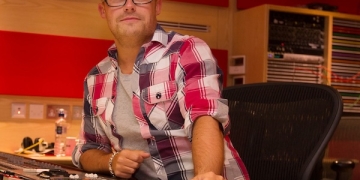





 Two years ago, Classic Hits WLS-FM Chicago brought back the signature jingle associated with the station throughout its 60-year history, including its Top 40 heyday from the ’60s to the mid-’80s. For programmers and jingle fans, it was the shotgun heard around the world. TM Studios’ Chief Creative Officer and Co-Owner Dave Bethell called it “one of the best responses for a custom package in a long time.”
Recently, TM Studios unveiled “WLS Classic Hits 2,” as well as a Hot AC package called “Mix2” designed for KHMX (Mix 96.5) Houston, Christian AC “KSBJ [Houston] 2,” and “Everything Country.” At a time of further consolidation and cutbacks, Bethell was also featured in these pages recently with “A Love Letter to the Industry.”
Bethell and the TM Studios team will be at Morning Show Bootcamp next week. He talks here about updating the WLS package, keeping the human element at a time when audio vendors are leaning more on AI, and MSBC itself.
How many stations is the original WLS package on now?
That’s a good question. I can tell you it’s dozens. It’s one of the most successful syndicated packages TM’s done in a very long time, and it’s gone global as well. A few running it in the U.S. include WSOX Harrisburg, Pa., KYBG (Big 102) Lafayette, La., and WJJK Indianapolis. One station I’m particularly proud of is KONO San Antonio, because they’ve just been nominated for a Marconi.
How did the update come about?
I had a conversation with [PD] Todd [Cavanah] around this time last year. It was really just a check-in to see how the package was. It had been on the air 16-18 months. The thing I love about Todd is that he is so passionate about music. He really cares, and it’s on a much different level than I think I’ve ever experienced with a programmer before. It was an hour-long call where he was talking song-by-song about how each song performs and how it fits on the station. [As WLS adds more ’90s titles] we discussed that as the benchmark of what the new package needs to be. We’re not just doing another package of ’80s jingles. It was about evolving the package with the format, adding in ‘90s styles, even some 2000s pop.
So, what makes a jingle appropriate next to Pearl Jam, or another ’90s Alternative song, knowing that those probably weren’t played next to jingles at the time.
That’s the kind of challenge I love. You’ve got to find a middle ground. You want to transition out of that song, but you don’t want it to scream or jar you … You want to give it the appropriate sound palette — it’s guitars, it’s drums, they’re loud but you can dial it back. There is the texture of driven guitars, but we won’t drive them as loud. We won’t have screamy vocals. First comes the 3-4 songs in the style that Todd would like a jingle in, then comes the creative ideas that make it sound like WLS, while also reflecting the genres.
There were 14 new cuts, including the top of the hour. [They’ll join most of the cuts from the existing package.] If any of the old cuts are retired, they won’t be removed entirely, they’ll just be hand-scheduled, because Todd is so smart, he even schedules the jingles. He’s not leaving that to the jocks. That’s part of what makes the station feel as exciting and great as it does.
It probably took about three months [to cut]. The previous package maybe took a little longer because we were dialing in the sounds. Now that we’ve done it once, we’re in a groove. As we do with most of our custom packages, we created about four cuts for Todd and got his thumbs up, then created the rest.
One of the big things about both WLS packages is that we work with live musicians—not remotely, not one player at a time, they’re all live in the room at the same time, playing together. We were trying to be authentic to the period. So, we were even using authentic analog techniques and hardware, then translating it back into digital to make it sound like it was from the early ’90s.
We’ll do a rhythm session with drums, bass, guitars, keyboards performing together. That’s another really important part of what we do. Back in the day, that’s how TM used to do everything. More recently, it’s all in the box — synthesized – so it’s nice when a package like this comes along where we can bring in live musicians.
Our guitarist, Andy Timmons, was in Danger Danger. He’s a legendary guitarist; we’re just lucky that he’s based in Dallas. He often plays with Ringo Starr’s All Starr Band. The drummer is a guy named Sean Curley. He’s a Granny winner and has performed on many hit records and toured with some of the biggest artists on the planet. We get to work with all these great session players, and that’s what gives it the authentic sound.
 TM’s advertising recently has been emphasizing the human element in this moment of AI. Tell me where having people made the difference in this process.
The first is the feel – you can’t control AI in the way that you can control the feel with a human, which is first of all these musicians playing off of each other … we always tell them play one take as it’s written in the charts, and then do your thing next time. Nine times out of 10, we’ll use the second take because they bring something — they bring vibe, they bring energy, they bring their experience, and often the happy accidents that end up contributing to the sound. So, there are those things that AI doesn’t capture because it’s just keywords [and] the accidents that change the direction of what the composition might be are completely taken out.
There are industry people who believe that AI will eventually be viewed the way synthesizers are now. Do you see legitimate uses for it in music?
Yeah, absolutely. I’m a fan of AI. The only time I have a problem with AI is when it’s in the hands of the tech businesses, and greed is associated with the product, where there is a race to be there first, or steal content from voices or musicians under the guise of fair use. In the hands of music creators, with the right intent, which is to provide a tool or a service that [saves] me time to do get back to the stuff that I want to do, [it’s like using ProTools].
If it’s suggesting a melody, giving inspiration, you type in a few words, and it gives you a riff, a rhythm, or even a sound, I don’t see that as anything different from sampling. Where I have a problem is where it’s learned from a body of work without consent. If its aim is to help me, great! If its aim is to replace me, while stealing all my music as learning material, then we have a problem!
The other issue I have with AI Music currently is the quality of what is being generated. What’s coming out the speakers isn’t as good. It might be fast. It might be quite impressive, but if you listen to Suno, it’s washy and noisy, and sounds like a low bitrate MP3 with resonance.
I use Ace Studio, which is similar to the way LLMs in AI clone voices, but instead trains off all the subtle nuances of a specific instrument or sound. I can play a piano melody, or I can sing my melody idea into it, and then go “I want that to be a sax,” and out comes a sax, and it sounds authentic and legitimate, and that’s an example of where it’s ethical, cool, fast, and helpful. It still doesn’t replace the real deal but often helps with demo ideas for clients.
So, if you were a radio programmer, would you play the Josh Fawaz version of “Like a Prayer” that is believed to be AI, and is the No. 1 airplay song in its native Australia?
I know the guy behind the [viral, AI-generated hit] “The Puerto Rico Song,” Saxboy Billy. I did a remix for him because it was a cultural moment. If you look at the comments, 50% of people think it’s really catchy and the other half see it as very toxic.
The other issue with AI is around honest disclosure. You don’t want to break the trust you have with the listener, because it takes one mistake to lose and another generation to rebuild. Me personally, I wouldn’t play “Like a Prayer” not just because it’s AI but because it doesn’t sound that good, It got that low Mpeggy MP3 sound to it, plus with how toxic AI can be to listeners, it’s just not worth it. If it’s a cultural moment, play Madonna’s version, it’s so much better.
Tell me about programmers’ attitudes towards jingles now. When the original WLS package happened, you were still dealing with a lot of programmers who wouldn’t consider them. Is that changing?
In a positive way, yes. I’m really excited about the fact that people are appreciating now what I’ve been saying all along,
Occasionally, there’ll be a programmer who doesn’t like jingles. They’re often outside of the demographic and I’ll explain that personal taste shouldn’t cloud their judgement. Some believe jingles aren’t cool to a younger audience, but’ll show them these cultural moments on social media, the catchy little viral 10-15 second clips that contain these hooky little earworms like “Oh No” [the Kreepa song built on a Shangri-Las sample] that are sitting in their heads all day and that they want to use in their videos. We’ve been doing that for 60 years, and it’s still working. That TikTok generation is about to [age into] your target audience.
There are anti-jingle people. We’ll put something together for them. When we do a demo, it’s ready to air, it’s not just a piano and a quick rough sing. We go through the process as if they’re a paid client. We’ll give them a four-week license and say stick it in your overnight show [or] go out in the market and play it for someone and ask if they like it and would remember it. Then let’s fine-tune it until we find the thing that works for you, and often we’re able to convert the anti-jingle person.
But the number of fans of jingles [is also] at an all-time high. People are more thoughtful now in what they want to achieve. Over 20 Marconi nominations went to TM clients; last year, it wasn’t even half that. That’s not just because we’ve increased our efforts in sales. That’s also because people are coming to us saying we get it.
Besides WLS, who have you repatriated to jingles (or gotten to use them for the first time)?
WDJX Louisville hasn’t run jingles in 25 years. Every programmer who came through there just couldn’t find the right sound, so it just didn’t land right. We worked hard with [PD] Ben [Davis] to find the sound. This is a really important part of [what we do]. We haven’t got just one generic sound that we slap on your station. We worked with them to find their ideal sound. Six months later, they won the Marconi CHR station of the year.
You’ll be at Morning Show Boot Camp next week. What’s your role there?
We’re there with no other reason than to just support the industry. I am a big fan of supporting the people coming through this industry in such a scary time, I have such respect for people that are sticking with it and believe in it.
MSBC reminds me of who the stars of tomorrow are, and what the passion is for radio, because you can get beaten down sitting in your little box here, doomscrolling about the negativity associated with corporate radio and AI and world events. I just see so much positivity when I go out and I meet these people, and they’re all in the room together with this good vibe and creativity and talent.
You also see all of these high-level talents that have been at the top of their game forever, but who check their ego at the door. Whether it’s a group programmer or a morning-show talent that is a celebrity, they are all approachable.
As we launch our new products, our priority is to help radio stations that believe that the listener comes first. That’s the bond of trust with the listener. We’re not anti-AI. We are just “human-first.” AI is fine, it’s like fast food, it’s cheap, and sometimes that’s what people want. Other times, people want Gordon Ramsay to make a nice, beautiful beef Wellington, and we’re here for that. And so, I’m just doubling down on prioritizing the artisan approach, the “human first” creativity part of our craft. We care about people. It’s really important that we protect the industry.