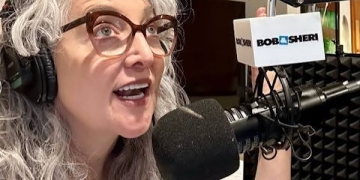





 On Tuesday, The Bob & Sheri Show was nominated for a NAB Marconi Award in the Network/Syndicated Personality of the Year category. But its most significant achievement has been the careful evolution of the syndicated show since Bob Lacey’s retirement in 2025.
Long before Lacey’s departure, host Sheri Lynch and syndication partner Tony Garcia brought in Jacobs Media. The pair invested in focus groups, perceptual research, and direct listener feedback to determine a way forward. The audience voted against the idea of a new voice in a familiar room. “They wanted the show to evolve naturally, with people they already knew and trusted,” Garcia says.
The solution was Lamar Richardson’s move into a larger role. Richardson “was never an outsider,” Lynch says. “He was part of the fabric of the show. He knew the rhythm, the audience knew him, and most importantly, the relationship was already real.
“But even with the audience’s deep familiarity with him, we couldn’t just drop him into the role. We brought him in gradually, increasing his mic time, eventually making him the third chair, so the audience could get comfortable with his expanded role, and to give us enough time to research the impact of his greater role on the audience,” she adds.
The payoff came in the most recent perceptual study: Two-thirds of listeners said the show is just as good since Bob’s retirement. Another 18 percent now like it better. Garcia sees the show as “built on relationships. It is family, food, pets, pop culture, real life, listener stories, and laughter,” and differentiated from “shows built around fake phone calls, staged drama, or recycled bits.”
The morning team also includes producer/show-runner Max Sweeten and associate producer Kary “Doc” Bowser. Its flagship outlet is Classic Hits WKQC (K104.7) Charlotte, N.C. On the eve of Morning Show Boot Camp, here are six questions with Lynch about the show today.
What can a morning show best do for listeners in today’s stressful world?
Our audience has been blunt: They don’t want any politics or hard news. None. Zero. They’ve been very clear about the role we play in their daily routine. We’re here to be their escape from that. The challenge is staying topical while avoiding toxic topics. The answer is you work harder. You dig deeper. It’s actually been a great creative challenge.
How do you get listeners to interact, now that they’re less likely to call a radio station?
Having listener voices on the air has always been our priority. We’ve seen the same drop-off in phone activity as everyone else. It reflects a massive shift in consumer behavior – we had to adapt, fast. One solution we’ve landed on is a feature on our Airkast app … we still promote phones, but our listeners have really embraced our Talkback feature.
How is your planning structured now in the “always creating extra content” world? It’s not post-mortem at 10:01, planning at 4 p.m., scour the newspapers at 5 a.m. anymore.
Honestly, I’ve spent my whole career in always-on mode. If I’m awake, I’m doing show prep. That’s just reality when your content is lifestyle-driven. Whatever our listeners are watching, reading, thinking, wearing, or eating – we’re living that same life. Social media has made that much easier than it used to be, that’s for sure.
Tell us a little more about how the succession plan for the show is playing out now.
We were super-lucky to have so much talent in the room to begin with. Listeners love Max and Lamar for good reason. They’ve earned the trust of the audience. Is it a different show now? Yes, in some ways, but the core DNA didn’t change. Plus, we were transparent throughout the whole evolution. There were no surprises. Bob had a chance to say goodbye to the people he’d spent his life entertaining. That’s not a given in our business. The audience saw us grieve his leaving. They saw us rally around Lamar in his new role. And they never doubted that we cared how they felt about it all, because they were a part of the decisions and the transition.
We just saw one of the world’s major morning teams, Kyle & Jackie-O, break up on-air over whether they were spending too much time on horoscopes. What’s the best way for a team to work together so it never implodes?
That just wouldn’t happen here. If there’s one thing we do well behind the scenes, it’s communication. We’ve been working together for a long time; we’ve earned each others’ trust. We talk about content before we turn mics on. And, back to research, we constantly ask the audience their thoughts and then make any adjustments or changes around that data. We have some listeners who hate astrology, for example, and others that love it. Because there are more that love it than don’t, we created a weekly zodiac feature.
That said, it’s hard to do a job like this without having some pretty big ego, right? It’s kind of the whole gig when your job title is “personality.” But that’s not a license to act like an entitled little maniac. When you have a listener giving you their most precious resource, their time, then you need to show up to work like a sane grown-up. It’s just basic respect. Your coworkers and your audience deserve that.
With listener attention pulled in so many directions, how do you keep your show top of mind?
You go where your listeners are, and you meet them there. And if you’re not sure where exactly that is – X? Facebook? Tik Tok? – you ask them. And then off you go to engage in authentic and organic conversations with the people who keep you employed.
I’ve seen every flavor of crazy when it comes to radio and social media – but strip away the jargon and it’s just people doing people things. Yeah, it’s great when you make a post that goes viral. But’s it’s also great to tag in for a birthday greeting, or a comment on a big life moment, or a dog chewing up a couch. That’s how you transform a passive audience into a community that engages with you and with each other. Radio is built for this kind of immediacy and intimacy. We don’t need to overthink it so much.








Great insight into the creation of an amazing radio show.
Thanks, as someone who is also a researcher, it was gratifying to see that investment pay off for them.