
• Latest
Ross On Radio Shorter Songs

Radio Finally Gets Shorter Songs, Now What?

7 years ago
Nielsen Audio Arbitron

Nielsen April 2026 Ratings Releases 6/3

3 hours ago
Mason's Observations Liveline

Mason’s Observations on Online Radio Listening

5 hours ago
Cumulus Media 2018 Mary Berner

Cumulus Media VP/Programming Operations Doug Hamand To Retire

5 hours ago
ADVERTISEMENT
Washington State Association of Broadcasters WSAB

Washington State Association of Broadcasters Names Jim Rose As New President/CEO

7 hours ago
Eastlan Ratings

Eastlan April 2026 Ratings Releases

9 hours ago
97.5 The Fanatic WPEN-FM Philadelphia

John Kinkade To Depart Mornings On 97.5 The Fanatic

11 hours ago
iHeartRadio app

iHeartRadio Launches Partnerships With LG & TextNow

11 hours ago
97.9 KGNC-FM Amarillo

Blair Garner Joins KGNC-FM Amarillo

14 hours ago
Y108 107.9 WDSY Pittsburgh Ally Butler Andy Davis

Mark Anderson Exits Audacy Pittsburgh

21 hours ago
Live 95.5 KBFF Portland

Dylan Salisbury Exits KBFF/KUPL Portland

21 hours ago
Got News? Let us know at [email protected]
RadioInsight
No Result
View All Result
  • Login
  • Register
  • Headlines
    • Format Changes
    • People & Places
    • Station Sales
    • FCC Applications
    • Domain Insight
  • Ratings
    • Nielsen Audio
    • Eastlan Ratings
  • Jobs
    • View Jobs
    • Submit A Job
    • Job Dashboard
  • Sean Ross
  • Subscriptions
    • Subscription Info
  • Contact Us
SUBSCRIBE
NEWSLETTER
RadioInsight
  • Headlines
    • Format Changes
    • People & Places
    • Station Sales
    • FCC Applications
    • Domain Insight
  • Ratings
    • Nielsen Audio
    • Eastlan Ratings
  • Jobs
    • View Jobs
    • Submit A Job
    • Job Dashboard
  • Sean Ross
  • Subscriptions
    • Subscription Info
  • Contact Us
No Result
View All Result
RadioInsight
No Result
View All Result

Radio Finally Gets Shorter Songs, Now What?

Sean Rossby Sean Ross
July 3, 2019


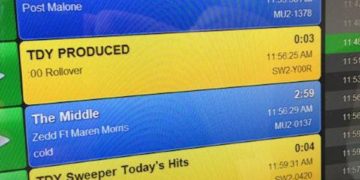
It began two months ago with a tweet from Scott Lowe, now heard doing a Classic Alternative show on WNYL (Alt 92.3) New York, but then on-air at CHR WTDY Philadelphia.

Are today’s pop songs getting shorter? I’ll bet there hasn’t been this many songs under 3 minutes on Top 40 radio since the 1960s. What do you think @RossOnRadio? #shortsongs pic.twitter.com/eWIzwCNbF6

— Scott Lowe Radio (@ScottyLiveShow) April 26, 2019

A few weeks later, it was RadioInsight.com publisher Lance Venta: “I’ve seen multiple Facebook group threads recently discussing how many CHR songs are 2:30 or less now.  Has QuickHitz [the controversial mid-’10s CHR format built around edited songs] won after all? Promo vet Kevin Powell also reached out to note the trend towards shorter hits around the same time.

More recently, Hot AC WDAQ (98Q) Danbury, Conn., PD/MD/morning host (and “Beat Shazam” ninja) Rich Minor e-mailed me. “I just looked at four current categories for 98Q. Of 21 songs total, fifteen of them are three minutes or under, and two more are barely over 3:00 . . . So when we say ‘more music,’ we really mean it.”

Minor wanted to know if other programmers were adjusting clocks to deal with the sudden glut of shorter songs. For his part, Minor has been dealing with his various hours differently. “Maybe one hour, it was adding a power recurrent . . . Another hour, maybe it was a song from the nights-only or overnights-only category, [but a song] that I can foresee moving to all dayparts soon [such as ‘Bad Guy’]. And another hour, I’d added a recurrent.”

I’ve been hearing about shorter songs from A&R friends for a while. A few months ago, I tried to get at why the hit music formula had become dependent on slower/more ethereal first verses, even on uptempo songs. What many talked about instead was the move to stream-friendly shorter songs.

It  took me at least two months to write a story about a two-and-a-half minute phenomenon. So much for instant gratification. But I do have some thoughts on shorter songs.

It’s one of several (faint) echoes of 1966. As Rich Appel notes, the AOR aesthetic hadn’t yet taken hold in 1966-67, and songs were regularly 2:30 or under. In 1966, top 40 hits also averaged about seven weeks on the chart. Now, there is at least one pile of songs that run their course relatively quickly. It’s not the paradigm, but there are a growing number of major artist songs (most notably “Me!”) that are big enough to compel radio’s attention, but not destined for power. They’re not stiffs in the traditional sense. They’re fireflies. They haven’t changed the paradigm of how radio develops songs—in the background, there are still songs like Post Malone, “Wow” or Sam Smith & Normani, “Dancing With A Stranger” taking 20 weeks to prove themselves as powers—but they’ve become a significant piece of the available hit music.

It’s not just happening with CHR/Hot AC music. When I asked Facebook friends how they were handling the shorter songs, I heard from a PD who programs a Rhythmic Christian CHR station and another programming Spanish-language/English-language CHR hybrid. Both had adjusted their clocks as well.

This is the thing that radio once wanted. Many years ago. RKO Radio group PD Paul Drew led a brief, ineffective campaign to get artists and labels to supply shorter songs. The rise of rock radio and the album aesthetic had culminated in 5:40 of Elton John’s “Don’t Let the Sun Go Down On Me.” When “Bohemian Rhapsody” came out, I remember WRKO Boston briefly playing an edited version that excised the opera; they switched to the full version quickly. As its influence waned, Top 40 could come along for the ride, but not set the agenda.

Even when CHR was running things in 1983-85, many of the megahits were above four minutes and sometimes well-longer: “Billie Jean,” “Let’s Go Crazy” (depending on whether you played the full intro), “Dancing In The Dark,” “All Night Long (All Night),” “Everybody Wants to Rule The World,” “Don’t You (Forget About Me).” (To be fair, some of my lengths may be based on album versions to which Classic Hits stations are defaulting now than to edits available or self-produced at the time.)

This is the thing that radio tried to engineer for itself. The QuickHitz format, which edited current songs to about 1:45-2:15, was a year in the making, them flamed out quickly at CKMP (Amp 90.3) Calgary, Alberta, due to adverse publicity, and, in Canada where such things are possible, regulatory intervention. That dust-up always seemed like a control issue between artists and radio as much as an aesthetic one, and the sudden willingness by some acts to keep things brief seems to confirm it.

The industry isn’t doing it now for radio. They’re doing it now to drive streaming, and radio is again along for the ride. Shorter songs are more likely to get played all the way through. Shorter songs are easier to play over and over again. (By contrast, when I bought the Cars, “Just What I Needed” as a new single and played it 18 times in a row, Elektra only got paid once.) But we’re also seeing long songs with multiple changes to keep streamers interested. These days, it’s “Sicko Mode,” not “Bohemian Rhapsody” or “Hotel California,” that is the uneditable opus.

So far, broadcasters have responded in the correct way. A decade after the rise of Pandora, few broadcasters have addressed spot length or the misery of the broadcast streaming experience in any meaningful way. So I’m glad that the response to shortened songs has been to play more songs per hour. It would have been very easy for radio to just increase spotload. And you’ve got to wonder if somewhere somebody is trying to squeeze in one more unit for debt relief or prostate health.

Song length matters less when things are otherwise good. The variety of song lengths in 1983-85 proves it. Also, the resurgence of Queen (if it can be described as such, since the band never went away) after “Bohemian Rhapsody,” the movie, has reinforced three enduring megahits (“Bohemian Rhapsody,” “We Will Rock You/We Are The Champions,” and “Somebody To Love”) that are between 4:50 and 6:15. Shorter hits such as “Killer Queen” and “You’re My Best Friend” have gotten little or no bounce. Only “Another One Bites The Dust” and “Under Pressure” are enduring hits at a typical singles length.

The music of 1974 is polarizing, but I regard it as a great time for hit music. “Don’t Let The Sun Go Down On Me” was ponderous to me at 5:40; for others, it was a welcome antidote to “The Night Chicago Died.” But whatever your take on that year, 1975 was worse, and 6:45 of “Someone Saved My Life Tonight” might have had more gravitas than “Please Mr. Please” and “Only Women Bleed,” but not much else.

Similarly, in 1988, when Top 40 music seemed to be coming out of its 1986-87 downturn, George Michael could have however long he wanted for “One More Try.” As desperation set in again, 5:20 of “Freedom ‘90” wasn’t so helpful. (And that was the single edit.) And nothing says early ‘90s doldrums more than Elton and George doing 5:45 worth of “Don’t Let The Sun Go Down On Me” together. Yet, all that said, the Elton songs that endure now are the opuses—“Tiny Dancer,” “Rocket Man.” Even “Freedom ’90” seems to be experiencing a resurgence.

Song length is only one of the exciting things happening now. Short punchy hits are definitely increasing pop music’s long-elusive fun factor. But so is having a little more tempo. So is that more dynamic supply of usable product, something else that seems to be driven more by Spotify and its Today’s Top Hits playlist than by radio programmer enterprise. How and when people want to hear a song seems to be changing as dramatically as how long that song itself should be. How radio should bring music in and out of the system is likely to change as song lengths. More about that to follow.

Share This:

  • Share on LinkedIn (Opens in new window) LinkedIn
  • Share on Facebook (Opens in new window) Facebook
  • Share on X (Opens in new window) X
  • Share on Bluesky (Opens in new window) Bluesky
  • Share on Threads (Opens in new window) Threads
  • Share on Reddit (Opens in new window) Reddit
  • Print (Opens in new window) Print
  • Email a link to a friend (Opens in new window) Email
  • More
  • Share on Mastodon (Opens in new window) Mastodon
  • Share on Telegram (Opens in new window) Telegram
  • Share on WhatsApp (Opens in new window) WhatsApp
Sean Ross

Sean Ross

Sean Ross is a radio business researcher, programming consultant, conference speaker, and a veteran of radio trade journalism at Billboard, Radio & Records, M Street Journal, and others. For more than a decade, his weekly writings have been collected in the Ross On Radio newsletter; subscribe for free here. https://tinyurl.com/mhcnx4u

Comments

Log In

Join Now | Lost Password?

Leave a ReplyCancel reply

Recent Headlines

Nielsen Audio Arbitron

Nielsen April 2026 Ratings Releases 6/3

June 3, 2026
Cumulus Media 2018 Mary Berner

Cumulus Media VP/Programming Operations Doug Hamand To Retire

June 3, 2026
Washington State Association of Broadcasters WSAB

Washington State Association of Broadcasters Names Jim Rose As New President/CEO

June 3, 2026
Eastlan Ratings

Eastlan April 2026 Ratings Releases

June 3, 2026
97.5 The Fanatic WPEN-FM Philadelphia

John Kinkade To Depart Mornings On 97.5 The Fanatic

June 3, 2026
iHeartRadio app

iHeartRadio Launches Partnerships With LG & TextNow

June 3, 2026
Load More

RadioInsight Daily

GET RADIOINSIGHT HEADLINES DIRECT TO YOUR INBOX EVERY EVENING.

Newest Jobs

  • Radio One

    Promotions Director

    Radio One
    Indianapolis, IN
    • Full Time
  • Hubbard

    Afternoon Drive On Air Talent

    Hubbard
    Seattle, WA
    • Full Time
  • KZIA, INC

    Afternoon Drive / Content Creator

    KZIA, INC
    Cedar Rapids, IA
    • Full Time
  • SummitMedia, LLC

    Promotions Manager

    SummitMedia, LLC
    Birmingham, AL
    • Full Time
  • Mississippi Public Broadcasting

    Executive Producer/Host

    Mississippi Public Broadcasting
    Jackson, MS
    • Full Time
  • Eagle Communications, Inc.

    Sports and Production Director

    Eagle Communications, Inc.
    North Platte, NE
    • Full Time

Radio Finally Gets Shorter Songs, Now What?

Sean Rossby Sean Ross
July 3, 2019


It began two months ago with a tweet from Scott Lowe, now heard doing a Classic Alternative show on WNYL (Alt 92.3) New York, but then on-air at CHR WTDY Philadelphia.

Are today’s pop songs getting shorter? I’ll bet there hasn’t been this many songs under 3 minutes on Top 40 radio since the 1960s. What do you think @RossOnRadio? #shortsongs pic.twitter.com/eWIzwCNbF6

— Scott Lowe Radio (@ScottyLiveShow) April 26, 2019

A few weeks later, it was RadioInsight.com publisher Lance Venta: “I’ve seen multiple Facebook group threads recently discussing how many CHR songs are 2:30 or less now.  Has QuickHitz [the controversial mid-’10s CHR format built around edited songs] won after all? Promo vet Kevin Powell also reached out to note the trend towards shorter hits around the same time.

More recently, Hot AC WDAQ (98Q) Danbury, Conn., PD/MD/morning host (and “Beat Shazam” ninja) Rich Minor e-mailed me. “I just looked at four current categories for 98Q. Of 21 songs total, fifteen of them are three minutes or under, and two more are barely over 3:00 . . . So when we say ‘more music,’ we really mean it.”

Minor wanted to know if other programmers were adjusting clocks to deal with the sudden glut of shorter songs. For his part, Minor has been dealing with his various hours differently. “Maybe one hour, it was adding a power recurrent . . . Another hour, maybe it was a song from the nights-only or overnights-only category, [but a song] that I can foresee moving to all dayparts soon [such as ‘Bad Guy’]. And another hour, I’d added a recurrent.”

I’ve been hearing about shorter songs from A&R friends for a while. A few months ago, I tried to get at why the hit music formula had become dependent on slower/more ethereal first verses, even on uptempo songs. What many talked about instead was the move to stream-friendly shorter songs.

It  took me at least two months to write a story about a two-and-a-half minute phenomenon. So much for instant gratification. But I do have some thoughts on shorter songs.

It’s one of several (faint) echoes of 1966. As Rich Appel notes, the AOR aesthetic hadn’t yet taken hold in 1966-67, and songs were regularly 2:30 or under. In 1966, top 40 hits also averaged about seven weeks on the chart. Now, there is at least one pile of songs that run their course relatively quickly. It’s not the paradigm, but there are a growing number of major artist songs (most notably “Me!”) that are big enough to compel radio’s attention, but not destined for power. They’re not stiffs in the traditional sense. They’re fireflies. They haven’t changed the paradigm of how radio develops songs—in the background, there are still songs like Post Malone, “Wow” or Sam Smith & Normani, “Dancing With A Stranger” taking 20 weeks to prove themselves as powers—but they’ve become a significant piece of the available hit music.

It’s not just happening with CHR/Hot AC music. When I asked Facebook friends how they were handling the shorter songs, I heard from a PD who programs a Rhythmic Christian CHR station and another programming Spanish-language/English-language CHR hybrid. Both had adjusted their clocks as well.

This is the thing that radio once wanted. Many years ago. RKO Radio group PD Paul Drew led a brief, ineffective campaign to get artists and labels to supply shorter songs. The rise of rock radio and the album aesthetic had culminated in 5:40 of Elton John’s “Don’t Let the Sun Go Down On Me.” When “Bohemian Rhapsody” came out, I remember WRKO Boston briefly playing an edited version that excised the opera; they switched to the full version quickly. As its influence waned, Top 40 could come along for the ride, but not set the agenda.

Even when CHR was running things in 1983-85, many of the megahits were above four minutes and sometimes well-longer: “Billie Jean,” “Let’s Go Crazy” (depending on whether you played the full intro), “Dancing In The Dark,” “All Night Long (All Night),” “Everybody Wants to Rule The World,” “Don’t You (Forget About Me).” (To be fair, some of my lengths may be based on album versions to which Classic Hits stations are defaulting now than to edits available or self-produced at the time.)

This is the thing that radio tried to engineer for itself. The QuickHitz format, which edited current songs to about 1:45-2:15, was a year in the making, them flamed out quickly at CKMP (Amp 90.3) Calgary, Alberta, due to adverse publicity, and, in Canada where such things are possible, regulatory intervention. That dust-up always seemed like a control issue between artists and radio as much as an aesthetic one, and the sudden willingness by some acts to keep things brief seems to confirm it.

The industry isn’t doing it now for radio. They’re doing it now to drive streaming, and radio is again along for the ride. Shorter songs are more likely to get played all the way through. Shorter songs are easier to play over and over again. (By contrast, when I bought the Cars, “Just What I Needed” as a new single and played it 18 times in a row, Elektra only got paid once.) But we’re also seeing long songs with multiple changes to keep streamers interested. These days, it’s “Sicko Mode,” not “Bohemian Rhapsody” or “Hotel California,” that is the uneditable opus.

So far, broadcasters have responded in the correct way. A decade after the rise of Pandora, few broadcasters have addressed spot length or the misery of the broadcast streaming experience in any meaningful way. So I’m glad that the response to shortened songs has been to play more songs per hour. It would have been very easy for radio to just increase spotload. And you’ve got to wonder if somewhere somebody is trying to squeeze in one more unit for debt relief or prostate health.

Song length matters less when things are otherwise good. The variety of song lengths in 1983-85 proves it. Also, the resurgence of Queen (if it can be described as such, since the band never went away) after “Bohemian Rhapsody,” the movie, has reinforced three enduring megahits (“Bohemian Rhapsody,” “We Will Rock You/We Are The Champions,” and “Somebody To Love”) that are between 4:50 and 6:15. Shorter hits such as “Killer Queen” and “You’re My Best Friend” have gotten little or no bounce. Only “Another One Bites The Dust” and “Under Pressure” are enduring hits at a typical singles length.

The music of 1974 is polarizing, but I regard it as a great time for hit music. “Don’t Let The Sun Go Down On Me” was ponderous to me at 5:40; for others, it was a welcome antidote to “The Night Chicago Died.” But whatever your take on that year, 1975 was worse, and 6:45 of “Someone Saved My Life Tonight” might have had more gravitas than “Please Mr. Please” and “Only Women Bleed,” but not much else.

Similarly, in 1988, when Top 40 music seemed to be coming out of its 1986-87 downturn, George Michael could have however long he wanted for “One More Try.” As desperation set in again, 5:20 of “Freedom ‘90” wasn’t so helpful. (And that was the single edit.) And nothing says early ‘90s doldrums more than Elton and George doing 5:45 worth of “Don’t Let The Sun Go Down On Me” together. Yet, all that said, the Elton songs that endure now are the opuses—“Tiny Dancer,” “Rocket Man.” Even “Freedom ’90” seems to be experiencing a resurgence.

Song length is only one of the exciting things happening now. Short punchy hits are definitely increasing pop music’s long-elusive fun factor. But so is having a little more tempo. So is that more dynamic supply of usable product, something else that seems to be driven more by Spotify and its Today’s Top Hits playlist than by radio programmer enterprise. How and when people want to hear a song seems to be changing as dramatically as how long that song itself should be. How radio should bring music in and out of the system is likely to change as song lengths. More about that to follow.
Share This:

  • Share on LinkedIn (Opens in new window) LinkedIn
  • Share on Facebook (Opens in new window) Facebook
  • Share on X (Opens in new window) X
  • Share on Bluesky (Opens in new window) Bluesky
  • Share on Threads (Opens in new window) Threads
  • Share on Reddit (Opens in new window) Reddit
  • Print (Opens in new window) Print
  • Email a link to a friend (Opens in new window) Email
  • More
  • Share on Mastodon (Opens in new window) Mastodon
  • Share on Telegram (Opens in new window) Telegram
  • Share on WhatsApp (Opens in new window) WhatsApp
Sean Ross

Sean Ross

Sean Ross is a radio business researcher, programming consultant, conference speaker, and a veteran of radio trade journalism at Billboard, Radio & Records, M Street Journal, and others. For more than a decade, his weekly writings have been collected in the Ross On Radio newsletter; subscribe for free here. https://tinyurl.com/mhcnx4u

Log In

Join Now | Lost Password?

Comments

Leave a ReplyCancel reply

Recent Headlines

Nielsen Audio Arbitron

Nielsen April 2026 Ratings Releases 6/3

June 3, 2026
Cumulus Media 2018 Mary Berner

Cumulus Media VP/Programming Operations Doug Hamand To Retire

June 3, 2026
Washington State Association of Broadcasters WSAB

Washington State Association of Broadcasters Names Jim Rose As New President/CEO

June 3, 2026
Eastlan Ratings

Eastlan April 2026 Ratings Releases

June 3, 2026
97.5 The Fanatic WPEN-FM Philadelphia

John Kinkade To Depart Mornings On 97.5 The Fanatic

June 3, 2026
iHeartRadio app

iHeartRadio Launches Partnerships With LG & TextNow

June 3, 2026
Load More
  • About RadioInsight
  • Privacy Policy
  • Terms of Service

Copyright ©2025 RadioInsight / RadioBB Networks

Welcome Back!

Login to your account below

Forgotten Password? Sign Up

Create New Account!

Fill the forms below to register

*By registering into our website, you agree to the Terms & Conditions and Privacy Policy.
All fields are required. Log In

Retrieve your password

Please enter your username or email address to reset your password.

Log In
No Result
View All Result
  • Headlines
    • Format Changes
    • People & Places
    • Station Sales
    • FCC Applications
    • Domain Insight
  • Ratings
    • Nielsen Audio
    • Eastlan Ratings
  • Jobs
    • View Jobs
    • Submit A Job
    • Job Dashboard
  • Sean Ross
  • Subscriptions
    • Subscription Info
  • Contact Us
  • Login
  • Sign Up

Copyright ©2025 RadioInsight / RadioBB Networks

This website uses cookies. By continuing to use this website you are giving consent to cookies being used. Visit our Privacy Policy.