




 In fall 1979, just as their brief American hit streak was trailing off, Abba finally toured North America. They scheduled one of the relatively few tour dates for my hometown of Washington, D.C., but I had already left for college a few weeks earlier. Then they cancelled that show anyway. Then “Super Trouper,” the song, made it clear how much they hated touring in the first place. Then Abba broke up. It was always unlikely that I would ever see them live. Many years later, I tracked down Abba: The Movie, filmed at the heights of Abbamania on an Australian tour, and that was as close as I expected to get.
A few years ago, I was fortunate to have radio business in Finland, and I arranged a side trip to Stockholm to see the Abba Museum. That visit was preceded by lunch with a friend and some of the other Swedish radio people he had gathered. None of them had visited the museum. Only one was likely to go, because “my mom wants me to take her.” But the museum was good–creatively curated, lots of different exhibits and activities for any level of fan.
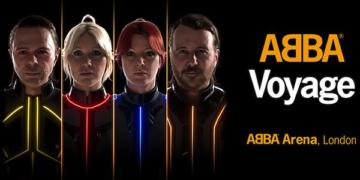
Earlier this year, I was on a panel at Radiodays Europe. This time I routed myself to Prague through London to see Abba Voyage, the elaborate virtual concert experience created by the group itself, in an effort to reclaim the act’s live legacy from a slew of tribute acts, some of which, like Bjorn Again, dated back to when tribute bands were relatively novel. Abba Voyage uses avatars to let the audience experience the group in various mid-’70s-to-early-’80s phases.
Abba Voyage opened last summer on the heels of a 2021 reunion album, also called Voyage, which was nice to have (especially for the rapprochement between group members that came with it), but felt like the tamest re-creation of early-1980s Abba without any Max Martin-type updating of the legacy. (The best “recent” Abba record thus remains “Summer Son” by Texas from 1999.) Voyage still gave the group a coda on the UK charts, and two years’ worth of Grammy nominations here.
It was perhaps for that reason that I was more interested in the Abba 1979 concert experience than I would have been in a reunion tour, even if there had been one. Over the last decade, I’ve been to a number of shows with heritage acts with wildly disparate results. I saw Gordon Lightfoot with his lower register gone and with it his smoky warmth. I saw an American touring version of the Sweet whose brand-new lead-singer needed a lyric stand to remember “it’s/it’s/the ballroom blitz.” I saw the Genesis farewell tour that sounded like a really impressive remaster of the Greatest Hits album, until the vocals.
But when you see shows by veteran artists, your ticket comes with an implied contract for a different kind of concert experience. After a number of missed opportunities, I was glad to have seen Lightfoot, and glad that he toured as long as he could. I saw Genesis with a rapturous audience that clearly respected Phil Collins’s Herculean effort to tour at all. The Sweet concert was the biggest disappointment — the closest thing to a real-life Spinal Tap experience.
But there were also shows that exceeded expectations. There was Stevie Wonder on the Songs of the Key of Life tour, whose call-and-response with his backup singers was there to make clear what notes he could still hit. (It was also impressive for stamina – the live performance of a 2-1/2 album set, followed by greatest hits.) I didn’t have any particular investment in seeing Dave Mason live in a small auditorium. That was a great show by an artist who seemed seasoned, not diminished, by years on the road, although I didn’t have any basis of comparison.
When I saw Voyage, the concert, the debate about the use of AI in radio had just erupted. Futuri’s Daniel Anstandig, whose RadioGPT product was the catalyst, was Radiodays Europe’s hastily added keynote speaker. Over the last five months, I’ve shared a lot of my concerns about the deployment of AI by broadcasters who already seem technology-challenged. Throughout, I’ve allowed for the possibility of positive uses, and my willingness to travel halfway around the world for a “concert” enabled by virtual reality proves my sincerity.
Abba Voyage was a very satisfying 90 minutes. What it offered didn’t look like a hologram of Princess Leia in a beam of light as much as a mostly realistic concert experience that was roughly 60% of the members “on stage” and 40% projections. (From my halfway point in the theater, I mostly watched the screens, as I would have done at any typical concert.) Several numbers were given over to anime or videos altogether, and rather than compete with memories of the band’s star-making performance of “Waterloo” at 1974’s Eurovision, they simply showed that version.
The Abba Voyage audience was asked not to take pictures or video or do anything that would ruin the surprise for others. My notes below are roughly comparable to what I’ve seen in other reviews, but if you are planning to see the show and want to come to it entirely cold, you should skip past these bullet points.
- The characters “onstage” were largely realistic, but a little oddly proportioned, as if they were around eight feet tall.
- On screen, the two male members looked a little more realistic than the two women, who seemed a little more animated. Ironically, at Anstandig’s keynote, an audience member would observe that RadioGPT’s AI-generated male voices seemed more realistic than its females.
- All four members had their own onstage monologue. Benny’s interlude, the first, worked the best. The others played more like footage from an official documentary than an exchange with the audience.
- The audience, mostly 45-plus, was appropriately enthusiastic. The one exception seemed to be applauding at the end of songs — the response was always enthusiastic enough, never rapturous or entirely giving into the illusion.
- The set list contains a few of the album cuts that are secret handshakes among fans (“Hole in Your Soul,” “The Visitors”). There was a surprisingly long segment of late-’70s/early- ’80s Eurodisco Abba, from after the group’s U.S. hit streak had tapered off.
- “Does Your Mother Know,” a song unlikely to be written too much later than 1979, was handled as it was in the musical Mamma Mia — Bjorn introduced it, but a backup singer took the lead vocal and gave it a female POV.
- The surprise omission was “Take a Chance on Me,” probably Abba’s second-most-enduring song after “Dancing Queen.” In the UK, you could also argue that “One of Us,” Abba’s last hit and one heard a lot on European radio over the years, was missing as well.
My interest in seeing Abba Voyage was the very special set of circumstances surrounding it. It doesn’t extend to a lot of other artists. I would have enjoyed seeing Bill Withers perform in his last years, but I wouldn’t rush to see his hologram now. (For his part, Withers and another ’70s artist I missed, Hot Chocolate’s Errol Brown, were both candid about being grateful to retire early, rather than decline visibly on stage, and I certainly respected that.)
For AI in radio, a lot of the question is “what is worth recreating?” The closest thing I can imagine to Abba Voyage is if the voice of Casey Kasem were somehow redeployed to generate new episodes of American Top 40. Perhaps the shows from the first six months of 1970, before AT40’s July 4 debut, could be added. Maybe a show focusing on the real ’70s charts that weren’t heard because that week’s show was a special themed countdown? Maybe shows from the late-’80s weeks that Shadoe Stevens was hosting before Kasem had debuted his own Casey’s Top 40?
The obvious difference is that Kasem is not among us, and even when he was, the control for his guardianship was so openly chaotic that there could be no orderly Abba-esque plan for his legacy. Listening to reruns of AT40 on a regular basis also opens questions about how you would write for him now, and where one would try and send the time machine. Well into the ’70s, Kasem was still referring to adult female artists as “girl singers.” On the Saturday #AT40 Twitter thread, participants flag those comments but can chalk them up to the tenor of the times, just as they do with “Does Your Mother Know.” But if you were starting fresh, would you want Kasem to #dobetter now?
Those Saturday AT40 listeners are generally divided on ’70s pop and the poppier side of disco. Some are there to hear “I Do, I Do, I Do, I Do, I Do.” Others let us know every week that they had long fled to AOR radio by that time. I’m already on record as having stuck with pop, disco, and R&B during the late ’70s.
Oldies, too. In the movie version of Christine, Stephen King makes “The Name of the Game” a symbol of the teenage hero’s dweebiness, until owning a vintage car makes him into a ’50s cool cat. But I always heard Abba’s place on the thru-line from Eddie Cochran to ’70s glam and bubblegum. Also, as a music researcher, I can tell you that Classic Hits listeners, who often seem to group Abba and the Grease soundtrack, seem to understand that at some level.
Because Abba both endures and polarizes decades later, the answer to who should see Abba Voyage is an easy one. If you have even briefly thought that you might enjoy it, you almost certainly will. For most fans, it won’t occasion intercontinental travel, but it might be worth a trip to wherever the show ends up in North America. (Toronto seems a likely candidate.) Meanwhile, in the UK, it certainly has done its intended job of spurring further interest in Abba Gold and the group’s catalog.
Abba Voyage is an advertisement for the responsible intersection of culture and technology, created from a position of strength that radio’s adventures in AI aren’t similarly able to begin from. But Abba’s endurance is also a reminder of the potential for reinvention through ways both intended (Mamma Mia, the musical) and unimaginable by its creator (Muriel’s Wedding). That part is absolutely relevant as radio looks for ways to be cool to new generations of listeners.