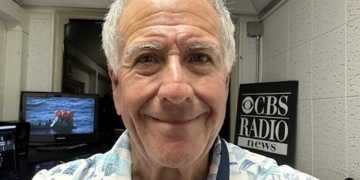




Peter King spent over three decades at CBS News Radio, anchoring hourly newscasts and covering everything from space shots to hurricanes, winning multiple awards for his space and Breaking News coverage. He shares this two part tribute to the network ahead of its shutdown on May 22. You can reach him at pkingnews62@gmail.com
 I think I can speak for my coworkers when I say I’m grateful for all of the media coverage and support surrounding the pending demise of CBS News Radio. Much has been reported about our storied history and our founding fathers-and rightfully so. But I fear that readers and those who viewed the recent “CBS Sunday Morning” piece might get the mistaken impression that CBS News Radio’s glory days ended with Edward R. Murrow. Sadly, the people who’ve kept CBS News Radio thriving for decades after the Murrow era have all but been ignored.
In culling through my own work archive (1994-2026) for retrospectives for the TV and radio side, I rediscovered what I thought was a long lost aircheck of my biggest single day on the air- the day space shuttle Columbia fell out of the sky (February 1, 2003). What was supposed to be a landing broadcast of about five minutes turned into a nearly 8 and a half hour long marathon as the story unfolded.
I was on the air with George Washington University Space Policy Director John Logsdon for the first hour, as the first details came in. Dan Raviv took over as the lead anchor after that. There has never been anyone better at longform radio and tying everything together than Dan.
I continued to report from the Kennedy Space Center as other correspondents and reporters joined the coverage. They included White House Correspondents Mark Knoller, briefly, and then, Peter Maer, for the duration. World News Roundup anchor Christopher Glenn had previously been our space correspondent and was at the Cape when Challenger exploded. KRLD reporter Rob Milford was in north Texas, following the hunt for wreckage and sadly, astronauts’ remains. KNX’s Frank Mottek and CBS’s Steve Futterman were at the Jet Propulsion lab in Pasadena. Reporters Stephan Kaufman in Spokane and Ranjan Gupta in India, the birthplaces for two of the crew members. CBS News Space Consultant Bill Harwood, my broadcast partner for more than 60 space shuttle launches and landings, added his invaluable expertise.
Anchoring updates and hourly newscasts from the Broadcast Centers in New York and Washington were future Roundup anchor Steve Kathan, Steve Knight, Charlotte Burke and Howard Arenstein.
Producer Kathleen Biggins started it off and held it together for the first difficult hour. Executive Producer Charlie Kaye quickly got to the BC to pull all of the elements together. He’s always the guy you want “driving the bus” when everything hits the fan. We had live and recorded interviews with witnesses, astronauts, family members and more. Listening to it all for the first time since that day reminded me of just how amazing CBS News Radio has been, especially when it came to big events.
Of course, stories like this don’t happen every day but the news does, 24/7. And our correspondents, writers, editors and expert engineers have been there for every bit of it. Since 1999, their work has won 84 Edward R. Murrow awards including 7 for Breaking News, 18 for Best Newscast, 16 for Overall Excellence and 12 for Continuing Coverage. I’ll tell you more about the people who made this happen in our next chapter.












 Ian Bush
I do not accept that the network could not be sold. There are entities who can and will operate the network properly, efficiently and profitably. Come on, CBS, sell don’t shutter.
Already too late. And even if there was a potential buyer, the costs associated with breaking it off the rest of the network would’ve been too much that Paramount would’ve lost more money than simply shutting it down.
Would love to hear this tape, Peter — hope you can upload it to preserve history!